Criminal Background Check for Colombia Visa: Complete 2026 Guide
Table of Contents
- Understanding the Colombia Visa Background Check Process for US Veterans
- Essential Preparations for Your Colombia Visa Background Check
- Step 1: Identify Which Background Check Colombia Requires for Your Visa
- Step 2: Obtain Your FBI Identity History Summary Check
- Step 3: Authenticate Your FBI Check with an Apostille from the U.S. Department of State
- Step 4: Translate Your FBI Background Check into Spanish by a Certified Professional
- Step 5: Evaluate the Impact of Your Criminal Record on Visa Eligibility
- Step 6: Choose the Right Visa Category and Understand Validity Periods
- Step 7: Submit Your Documents and Avoid Common Rejection Pitfalls
- Resolving Common Issues with Visa Background Check Processing
- Starting Your New Life in Colombia with the Right Visa Preparation
Understanding the Colombia Visa Background Check Process for US Veterans
A criminal background check for a Colombia visa requires US veterans to obtain an FBI background check, then get it apostilled by the U.S. Department of State and translated into Spanish by a certified professional. This mandatory document forms part of the Migrant visa application, which accepts recurring disability or pension income from the VA to meet Colombian financial requirements.
Field guides for US veterans, published by VeteranHousingColombia, explain that the FBI check must be current and that the apostille verifies its authenticity for international use. Once apostilled, a certified Spanish translation is required before submission to immigration authorities. The Migrant visa provides a three-year stay, with the option to apply for permanent residency after five years, and allows veterans to use VA benefits as reliable income for the application.
Getting these documents in order takes careful coordination, and the following guide outlines the essential preparations.
© VeteranHousingColombia / Published by ColombiaLiving.vet
Key Takeaways
- The first step is to determine which background check Colombia demands for a specific visa.
- The FBI Identity History Summary Check is the mandatory federal criminal record verification that U.S.
- The Colombian consulate clarifies that the FBI Identity History Summary Check is a federal record, so under the Hague Apostille Convention it must be authenticated with an apostille to the U.S.
- A criminal background check for a Colombia visa must be professionally translated into Spanish before Colombian immigration will accept it.
- Colombia’s immigration rules under Resolution 5477 make a criminal background check for a Colombia visa mandatory for Migrant, Resident, and pensioner visa applicants, even those who have a spotless record.
Essential Preparations for Your Colombia Visa Background Check
With the background check process understood, the focus turns to the concrete steps that make an application ready for submission. For a U.S. veteran, the centerpiece document is the FBI criminal history report, and it must be prepared with two supporting elements.
First, as Veteran Housing Colombia’s guidance notes, the FBI report requires an apostille from the U.S. Department of State. Because the United States is a signatory to the 1961 Hague Convention, this apostille replaces the older consular legalization process. Second, the report and its apostille must be accompanied by a certified Spanish translation from a professional translator; Colombian immigration authorities do not accept English-only documents.
Resolution 5477 of 2022 formalized these obligations. Nexo Legal explains that the resolution mandates criminal record certificates for Migrant, Resident, and pensioner visa categories and applies regardless of nationality, and they emphasize that an apostille, not a notarized copy, is required. The firm also warns that submitting an outdated certificate can lead to application delays.
Before starting a criminal background check for a Colombia visa, applicants should confirm they have access to a certified translator and understand the apostille timeline. With these preparations in hand, the next priority is identifying the specific background check format required for the chosen visa type.
Step 1: Identify Which Background Check Colombia Requires for Your Visa
The first step is to determine which background check Colombia demands for a specific visa.
Most U.S. veterans will need the FBI Identity History Summary Check, a federal fingerprint-based search of criminal records. Veterans from other countries should locate the equivalent national police certificate issued by their home country.
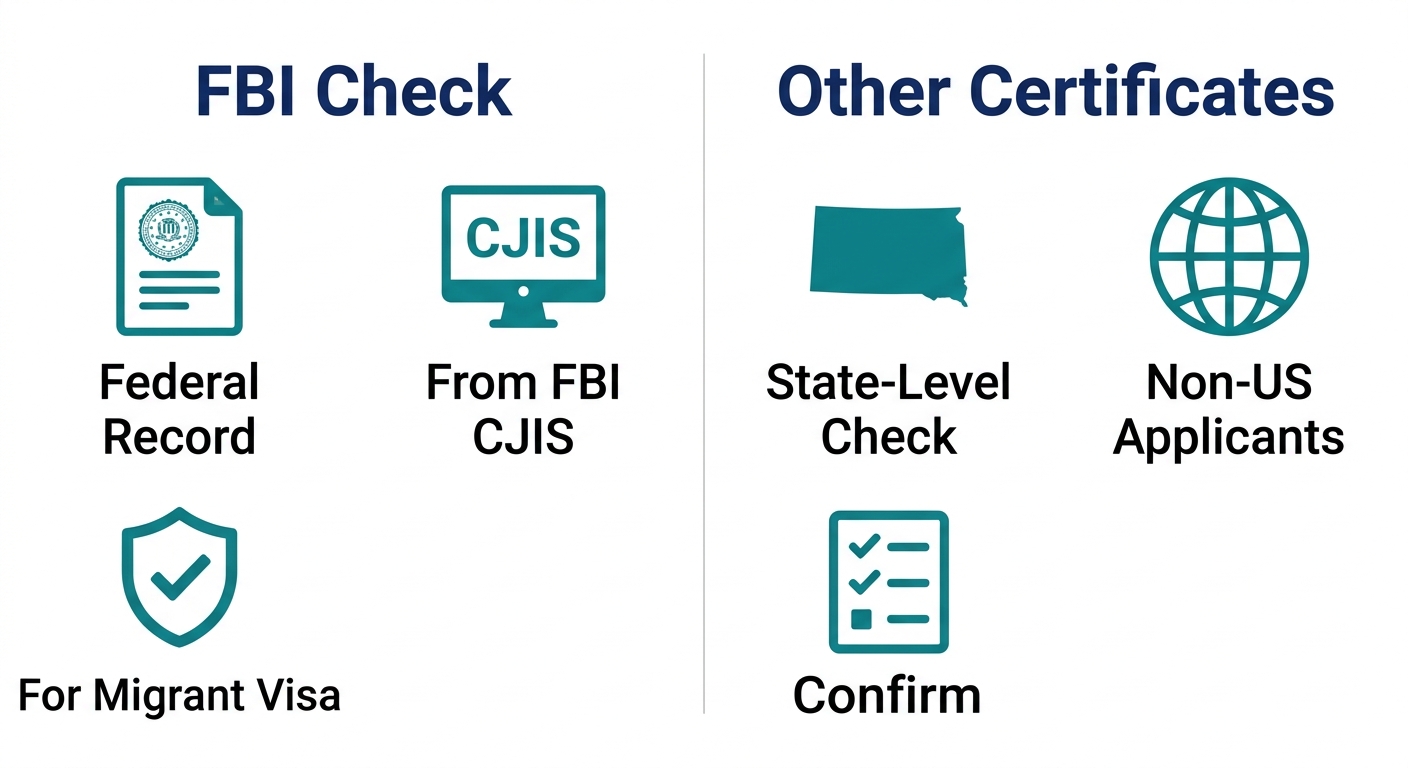
Colombia's Resolution 5477 requires a criminal records certificate for Migrant, Resident, and pensioner visa categories. That certificate must be apostilled and translated into Spanish. The Consulado de Colombia en Los Ángeles notes that the Colombian consulate does not process or apostille FBI checks; the U.S. Department of State handles federal document authentication under the Hague Apostille Convention.
Once a veteran confirms the FBI Identity History Summary Check is the correct requirement, they can proceed to obtain it, the topic of the next step.
Step 2: Obtain Your FBI Identity History Summary Check
The FBI Identity History Summary Check is the mandatory federal criminal record verification that U.S. applicants must provide for Colombian residency or migrant visas. According to the Consulado de Colombia en Los Ángeles, the Colombian consulate does not process or apostille these checks, only the U.S. Department of State can authenticate federal documents under the Hague Convention.
The FBI criminal background check for visa application is requested through the FBI’s CJIS division online or by mail, using an FD-258 fingerprint card. Once the report arrives, it must be professionally translated into Spanish, as required by Colombian immigration. For the Migrant visa, veteran applicants need to show proof of recurring income like VA disability or pension payments, as the guidance emphasizes.
Understanding how to get the criminal background check for the visa is straightforward: submit fingerprints, receive the report, then obtain an apostille from the U.S. Department of State before Colombian authorities will accept it.
Step 3: Authenticate Your FBI Check with an Apostille from the U.S. Department of State
The Colombian consulate clarifies that the FBI Identity History Summary Check is a federal record, so under the Hague Apostille Convention it must be authenticated with an apostille to the U.S. Department of State — not from the consulate. Resolution 5477, which governs criminal record certificates for Colombian visa applications, requires this apostille for Migrant, Resident, and pensioner visa categories before any Spanish translation takes place. Completing this step before translation is essential, because Colombian immigration will not accept the FBI check without the apostille. The U.S. Department of State’s Office of Authentications reviews the FBI seal and signature and attaches the apostille, confirming the document’s legitimacy under international law. After the apostille is affixed, the document is ready for certified Spanish translation, satisfying all Colombian visa requirements. Veterans and other U.S. visa applicants should plan for this authentication early, as processing can take several weeks.
Step 4: Translate Your FBI Background Check into Spanish by a Certified Professional
A criminal background check for a Colombia visa must be professionally translated into Spanish before Colombian immigration will accept it. Colombian authorities require that all documents in a foreign language accompany a certified Spanish translation.
Finding a certified translator.
Applicants can check with the Colombian consulate for a list of approved translators, search for traductor oficial online, or use services like the ones recommended in the field guides. According to Nexo Legal, the translation must be performed by a certified professional, not a bilingual friend or automated tool, to avoid rejection. Resolution 5477 explicitly mandates that criminal record certificates submitted in a language other than Spanish be paired with an official translation.
The translated document must always accompany the apostilled original when submitting the visa application. Keep the two documents together as a complete set.
Once the translation is complete, applicants should consider how any criminal record might affect visa eligibility.
Step 5: Evaluate the Impact of Your Criminal Record on Visa Eligibility
Colombia’s immigration rules under Resolution 5477 make a criminal background check for a Colombia visa mandatory for Migrant, Resident, and pensioner visa applicants, even those who have a spotless record. The certificate issued by U.S. authorities must be apostilled and accompanied by an official Spanish translation.
An apostilled FBI background check and its translation present the next consideration: whether any entry in the report could raise a flag with Colombian immigration. Minor or long-past offenses do not automatically block a visa, but the Colombian authorities weigh each situation on its own facts. The guide recommends that any applicant with a criminal history consult a licensed immigration attorney who can examine the specific circumstances and give a realistic assessment of the visa outlook.
With the record’s influence evaluated, the path forward becomes clearer: the next task is to choose the right visa category and learn how long it remains valid.
Step 6: Choose the Right Visa Category and Understand Validity Periods
For veterans with recurring pension or disability income, the Migrant visa is the clear pathway. This category accepts passive income like VA disability payments and may still be available even if you have a record, provided you prepare documents correctly.
An internal resource notes that the Migrant visa is typically issued for three years, but you should never rely on that alone. Because Colombian immigration regulations can be updated without notice, you must contact the Colombian Ministry of Foreign Affairs or the nearest consulate to verify the current validity period for your chosen category.
The required documents must be prepared correctly. All U.S. federal documents, including FBI background checks, need an apostille from the U.S. Department of State. Additionally, every document must be professionally translated into Spanish by a certified translator to be accepted by Colombian immigration.
Step 7: Submit Your Documents and Avoid Common Rejection Pitfalls
After selecting the right visa category, veterans must submit their background check documents correctly. The FBI Identity History Summary Check is the accepted federal record verification for a Colombian visa. That document must be professionally translated into Spanish by a certified translator; submitting an untranslated FBI check is a frequent cause of rejection. Federal documents like the FBI check require an apostille from the U.S. Department of State, not from a local notary or the Colombian consulate. The Colombian consulate does not process or apostille FBI background checks; applicants must use the U.S. Department of State for authentication. Veterans should ensure that both the apostilled FBI check and its certified Spanish translation are included in the final package. If the background check submission runs into processing delays or errors, the following section covers how to resolve common issues with visa background check processing.
Resolving Common Issues with Visa Background Check Processing
Even after you submit your documents, background check processing often trips up veterans. Here’s how to handle the most common snags. A common issue with the criminal background check for a Colombia visa is where to get the apostille. Other frequent pitfalls include forgetting to get an official Spanish translation and not knowing which visa categories require the certificate.
- Apostille location: The FBI Identity History Summary Check is a federal document, not a state record. Because the U.S. and Colombia are both Hague Convention signatories, the U.S. Department of State is the only authority that can apostille it—this replaces older consular legalization. According to the Consulate of Colombia in Los Angeles guide, the Colombian consulate does not issue or apostille FBI background checks; sending it there only causes delays.
- Certified translation: Once apostilled, the FBI report must be translated into Spanish by a certified translator. Resolution 5477, which took effect in October 2022, requires all criminal record certificates for Migrant, Resident, and pensioner visas to include an official Spanish translation, as Nexo Legal’s legal guide explains.
- Confirm your visa category: Veterans applying for a Migrant (Pensionado) visa should verify that it falls under Resolution 5477’s mandate. The same requirement applies to Resident and pensioner pathways, so confirming your category upfront prevents last-minute rejections.
Submitting the FBI background check without an apostille or translation is one of the most common reasons for visa application rejection. With your background check sorted and your visa on the right track, you are one step closer to settling into your new home.
Frequently Asked Questions
How to avoid visa rejection in 2026?
To avoid visa rejection, ensure your FBI background check is apostilled by the U.S. Department of State and accompanied by a certified Spanish translation. An untranslated or improperly authenticated document is a common cause of denial. You must also respond promptly to additional document requests within the 10-day window required by Colombian immigration.
Can you apply for a visa if you have a criminal record?
Yes, you can apply for a Colombia visa with a criminal record. Approval depends on the specific circumstances of the offense; minor or long-past offenses do not automatically block a visa. Colombian immigration evaluates each case individually, and consulting a licensed immigration attorney is recommended.
Will criminal record affect visa application
A criminal record can affect a Colombia visa application, but it does not automatically lead to rejection. Colombian authorities review each case on its own merits, and minor or old offenses may not pose a barrier. It is advisable to consult an immigration attorney to assess your specific situation.
Can you get a visa with a criminal record
Yes, you can get a Colombia visa with a criminal record. The outcome depends on the nature of the record, as Colombian immigration weighs each case individually. Minor or long-past offenses may not prevent approval, but seeking advice from a licensed immigration attorney is recommended.
Starting Your New Life in Colombia with the Right Visa Preparation
The criminal background check for a Colombia visa is the foundational requirement that makes relocation possible for US veterans. Once that document is secured, the remaining steps fit into a manageable pathway. The visa guide highlights three essential actions: obtaining an FBI background check, having it apostilled by the U.S. Department of State, and arranging a certified Spanish translation. The Migrant (M) visa category accepts recurring pension or disability income, giving many veterans an immigration route. With thorough preparation, veterans can move forward confidently. Those ready to take the next step can explore veteran residence guides that feature all-inclusive rooms and rates in Cocorná. This residence is not a medical or therapy program and provides no clinical services. All information is educational and not a substitute for professional medical, legal, or VA benefit advice. Individual circumstances and outcomes vary; consult a healthcare provider, VA representative, or immigration lawyer for personal guidance.
Start Your Life in Colombia
With your FBI background check apostilled and translated into Spanish, you've taken a major step toward your Colombian visa. The Migrant visa pathway, which accepts recurring pension or disability income, is a viable option for many veterans. Now that the paperwork is in order, it's time to think about where you'll live in this beautiful country. The organization offers all-inclusive residence guides to help you settle in the peaceful mountain pueblo of Cocorná. These guides include details on private rooms, meals, utilities, and a supportive community. You can explore the Cocorná Colombia guide to see the day-to-day reality and what to expect. Take the next step and start planning your new life among the waterfalls and rivers. Your adventure in Colombia begins when you're ready.