Colombia Visa Options for Veterans Living Abroad: Complete Guide
Table of Contents
- Colombia Visa Options for Veterans Living Abroad: Your FAQ
- Cost of Colombian Visas and Income Requirements for US Veterans
- Application Process and Required Documents for Veterans
- Visa Codes, Categories, and Permits Explained
- Timelines, Renewals, and Residency Pathways for Retirees
- Still Have Questions About Living in Colombia?
Colombia Visa Options for Veterans Living Abroad: Your FAQ
When you start researching your colombia visa options for veterans living abroad, it’s common to have a long list of questions. Do you need a visa to live in Colombia? Often yes, depending on your income and how long you plan to stay. While there is no exclusive colombia visa for veterans, the pensioner route is the most common path for those with VA disability or retirement income. The colombia pensioner visa is often the go-to long-stay option for veterans receiving regular benefits. Next, we break down the cost of Colombian visas and the income requirements for US veterans. For a broader housing resource, download our guía vivienda veteranos colombia, part of our Field guides for veterans in Colombia series, including our residence in Cocorná.
Cost of Colombian Visas and Income Requirements for US Veterans
Once you identify the visa pathway, the two immediate questions are what it costs and what income counts. Below we break down the 2025 numbers in Colombian pesos (COP) and US dollars (USD).
What is the minimum monthly income required for a Colombian pensioner visa in 2025?
Colombia no longer issues a stand-alone “pensioner visa”; the pensioner pathway now runs through the Migrant (M) / Resident (R) visa system. Under the migrant category you must show a regular monthly income of at least 3 times the legal monthly minimum wage (SMMLV). In 2025 the SMMLV is 1,423,000 COP, so the threshold is ≈ 4,269,000 COP — about USD $1,050 (early-2025 exchange rates). US Social Security retirement, Social Security disability, and VA disability compensation count as qualifying income. SMMLV rises each January and exchange rates fluctuate; budget about 5–10% above the published minimum.
Can VA disability benefits be considered valid income for a Colombian resident visa?
Yes — the deciding factor is the monthly payment amount, not your disability percentage. VA compensation, alone or combined with Social Security or other steady income, qualifies if it clears the required threshold. The visa process may require enrollment in the Colombian health system (EPS) or a qualifying private policy; this is an administrative requirement, not medical advice.
What are the overall costs of obtaining a Colombian residency visa?
Based on published sample pricing from ColombiaLiving.vet (early 2025), budget for:
- Government visa application/stamp fee (valoración): USD $50–$60 (≈ 200,000–240,000 COP)
- Cédula de extranjería (foreign ID) fee: USD $70–$80 (≈ 280,000–320,000 COP)
- Document translation and apostille: USD $100–$200
- Notary fees: USD $50–$100
- Optional visa-assistance/legal services: USD $200–$400
Total out-of-pocket often runs between USD $600 and $1,000. Official fees change annually and exchange rates move daily; treat these as sample pricing, not guarantees.
For veterans, moving abroad isn’t about leaving your benefits behind — your benefits don't stop at the border. With the costs and income picture settled, the next step is gathering the paperwork.
Application Process and Required Documents for Veterans
Once you’ve mapped out the costs and income, the next step is gathering the documents for your Colombian residency visa.
What documents do US veterans need for a Colombian residency visa?
To apply for residency in Colombia, gather these items:
- A valid US passport
- An FBI background check, stamped with an apostille (a certification that makes US documents valid in Colombia)
- Proof of income — VA disability award letters, pension statements, or Social Security benefit letters
- A marriage certificate if your spouse is applying with you
- A certified copy of your DD-214 discharge certificate
Processing times and formats vary; verify requirements with Migración Colombia. This checklist differs from standard retiree requirements. While retirees commonly use Social Security or civilian pensions, veterans often document income through VA disability or military retirement pay. The DD-214 is the key differentiator, not a higher income threshold.
Can you apply for a visa while in Colombia on a tourist permit?
Yes — you can enter Colombia on a tourist permit and submit your residency application to Migración Colombia while it remains valid. Present the same document package you would from abroad; have everything ready. Once approved, pay the applicable fee and receive your foreigner ID card (cédula de extranjería). Never overstay your tourist permit — fines and delays can follow.
Should veterans hire an immigration attorney for the Colombian visa process?
An attorney who understands US veteran paperwork can ensure your DD-214 and VA benefit letters are properly formatted for Migración Colombia. They coordinate translations and apostilles, structure your income evidence, flag policy changes, and catch small errors that delay applications. We work with a vetted referral partner, expatgroup.co, for visa assistance — not a guarantee of approval, but a resource tailored to veteran needs.
Once your paperwork is ready, understanding the specific visa codes and categories — covered in “Visa Codes, Categories, and Permits Explained” — determines which route fits you.
Visa Codes, Categories, and Permits Explained
With the paperwork sorted, the next real decision is which Colombian visa code fits your future.
What visa categories are available for US veterans moving to Colombia permanently?
Colombia organizes permissions under three broad codes: Visitor (V), Migrant (M), and Resident (R). For a retired US veteran aiming to live full-time in Colombia, the Resident (R) category is the clear path, specifically the pensionado resident visa. To qualify, you need a stable, provable monthly income—your military pension, VA disability, or Social Security payments all count. The system does not offer a special “veteran” visa; your service record is respected but doesn’t unlock extra privileges. What matters is the income stream meeting the government’s monthly threshold, not your branch or deployments.
Are there any restrictions or special policies for former military personnel applying?
No. Colombia has no veteran-specific visa tracks, fee waivers, or fast-pass lanes for former US military members. The same residency requirements, costs, and processing times apply to you as to any other foreign national. There are also no hidden restrictions—a veteran’s background check follows the identical security filter. The genuine obstacles are universal: clean criminal history, documented income, and accurate paperwork. Being a veteran is simply not a factor in the process.
What's the difference between a tourist permit and a resident visa?
A tourist permit (normally 90 days, extendable to 180 days per calendar year) grants temporary legal presence without work rights or a residency path. Overstaying can trigger fines and complicate future visa applications. A resident visa, in contrast, allows long-term living, may include work authorization, and opens the door to permanent residence and citizenship.
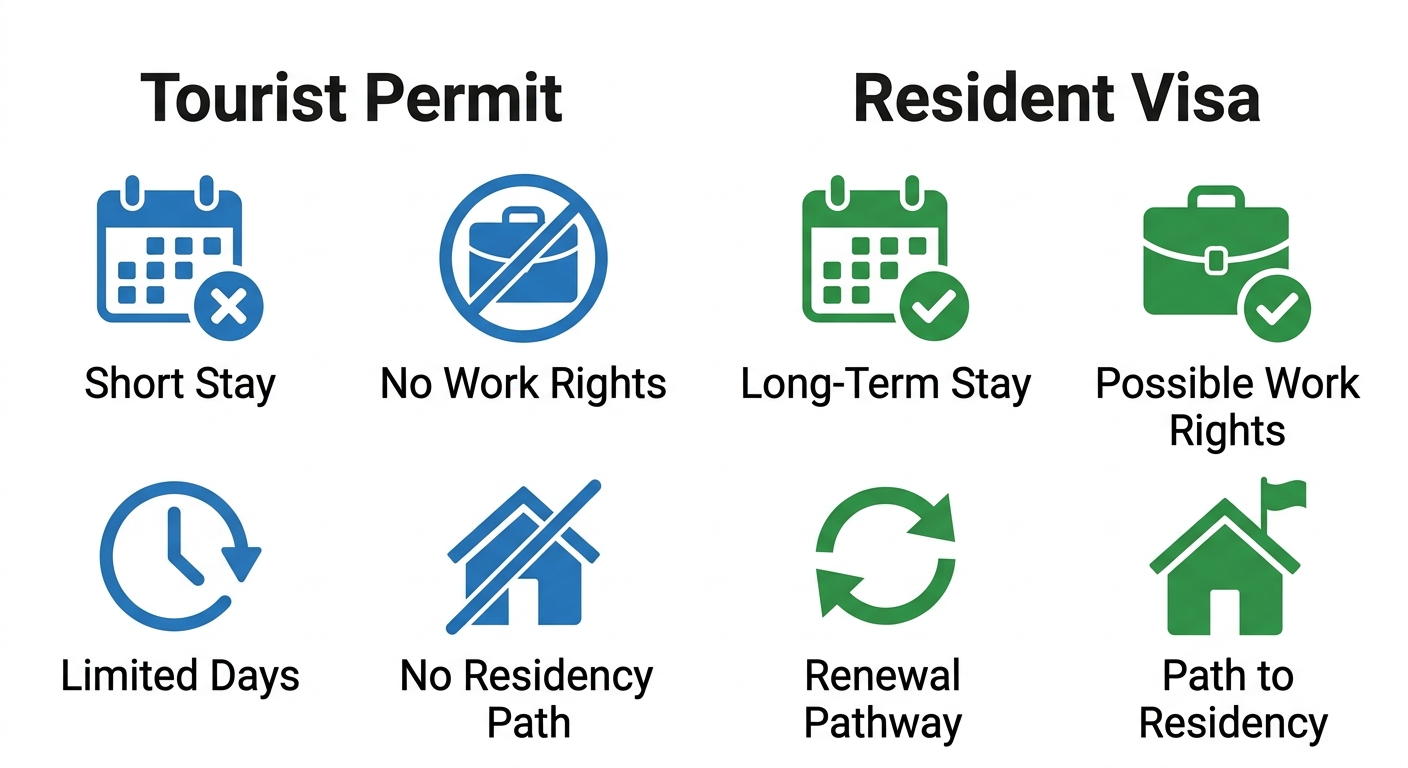 Tourist Permit vs Resident Visa features compared side by side
While the official paperwork can be daunting, ColombiaLiving.vet can connect you with vetted visa help through expatgroup.co—not an approval promise, just expert assistance. The category you select determines your renewal timeline and residency path, detailed next.
Timelines, Renewals, and Residency Pathways for Retirees
Now that you know which visa codes apply, let’s look at how long each status lets you stay and what it leads to.
How long can US citizens stay in Colombia on a tourist permit?
When you fly into Colombia with a US passport, the immigration officer typically stamps your passport for 90 days. If you want more time, you can apply to Migración Colombia for a single 90-day extension—bringing your total to 180 days within a calendar year. The exact length of your initial stay and whether the extension is approved depend on the officer and your situation. You cannot exceed 180 days per calendar year as a tourist, so plan your time in Colombia accordingly.
How long does the Colombian pensioner visa last and is it renewable?
The Colombian pensioner visa (M-11) is issued for up to three years—not forever. As long as you keep receiving the required monthly pension, you can renew it. To renew, submit your application before your current visa expires, provide updated pension and income documents, and follow the procedure either in-country or through a Colombian consulate. Starting your renewal a few months early eliminates last-minute stress.
Does time on a pensioner visa count toward permanent residency and citizenship?
Time you spend in Colombia on a tourist permit does not count toward residency, but every year you hold a valid pensioner visa contributes toward the five-year continuous-residence requirement for permanent residency. As long as you don’t leave Colombia for extended periods that break your continuous residence, those years add up. Once you obtain permanent residency, that status typically opens the door to citizenship eligibility after an additional period—often two or more years as a permanent resident. Keep in mind that immigration law can change, and the actual timeline can differ based on your individual record, so verify current rules with Migración Colombia or a trusted visa partner.
Still Have Questions About Living in Colombia?
Now that you understand the timelines and residency pathways, look at the bigger picture. From colombia visa options for veterans living abroad to cost-of-living tips, this guide was built to give you practical answers.
Reach out through our contact form or explore the free field guides covering VA disability, TRICARE, and Social Security. We offer visa assistance and referrals and a path toward our all-inclusive veteran residence in Cocorná. For legal, financial, or medical questions, consult a qualified professional.