Apostilled Documents for Colombia Retirement Visa: Essential Guide
Table of Contents
Mastering Apostilled Documents for Colombia Retirement Visa
Apostilled documents for a Colombia retirement visa are foreign records—your pension certificate and a recent criminal background check—that have received an apostille (a Hague Convention seal that verifies the signature’s authenticity, not the content) in the issuing country and then been translated into Spanish by a certified translator. According to visa guidance from Colombia Move, the Pensionado visa requires proof of a stable monthly pension of at least three times the Colombian minimum wage (about $1,723 USD in 2026), and only pension income from a recognized state or private fund qualifies; private savings, annuities, or dividends cannot substitute. Knowing which paperwork must carry that apostille is the essential first step—it lets you gather the right documents, avoiding delays that could postpone your Colombian residency.
Key Takeaways
- An apostille is an international authentication issued through the Hague Convention which certifies that a signed document has been verified and can be used in other member countries.
- Veterans from the U.S.
- The apostille is a Hague Convention certificate which validates signatures from one member state to be used in another member nation.
- The last step once you get your document apostilled is budgeting money to pay for both the apostille and its subsequent Spanish translation.
- In order to have an apostilled document accepted at Colombian immigration agencies, it must contain certified translations in Spanish.
1. Know Your Apostille Requirements
An apostille is an international authentication issued through the Hague Convention which certifies that a signed document has been verified and can be used in other member countries. Colombian immigration requires these foreign documents to have this form of authentication for visa applications, including the Colombian retirement visa.
U.S. applicants will have to go through the FBI Identity History Summary Check - the federal criminal background check that’s required as part of the application procedure for a Colombia retirement visa. Veteran Housing Colombia stresses the point that the apostille on this form has to be done by the U.S. Department of State alone, since neither local notaries nor the Colombian Consulate can apostille it. That being said, once you get your FBI report, you’ll need to send it off to the State Department, which takes a few weeks to finish up.
Veteran Housing Colombia states that Colombian immigration also requires certified Spanish translations from apostilled documents. Colombia Move also explains that while electronic apostilles could be accepted for certain types of visas, contacting the Ministry of Foreign Affairs to confirm this should be done first. After these rules have been established, the next step will be gathering the relevant documents needing apostilles.
2. Gather Vital Documents Ahead of Time
Veterans from the U.S. who want to apply for a Colombian retirement visa need to have two things at hand as soon as possible: an FBI Identity History Summary Check and a Social Security award letter.
The FBI Identity History Summary Check is the mandatory federal criminal background check for U.S. citizens applying for any Colombian visa. Under the 1961 Hague Convention, only the U.S. Department of State can apostille this FBI-issued document; local notaries or the Colombian consulate cannot authenticate it. Colombian immigration authorities also require a certified Spanish translation, and they reject applications that lack one.
Veteran Housing Colombia has published its own explanation as to why the Social Security Administration considers Colombia to be on List #2, which means that most primary worker benefits continue without interruption. Just like the FBI check, however, this federal document must be apostilled by the U.S. Department of State and then accompanied by a certified Spanish translation before the visa application.
Now that the two papers are in hand, the apostille step at the U.S. Department of State can begin.
3. Apostille Through the State Department
The apostille is a Hague Convention certificate which validates signatures from one member state to be used in another member nation. In order for a Colombia retirement visa applicant to submit federal government documentation such as Social Security award letter(s) & FBI identity history summary report(s), they will need to have those documents apostilled through the US Department of State.
In order to acquire an apostille, the applicant must fill out Form DS-4194 and mail the original document along with this form, the necessary payment, and a self-addressed return envelope to the U.S. Department of State’s Office of Authentications. The apostille can be digital in some cases, though you should check first with the Colombian Ministry of Foreign Affairs before proceeding.
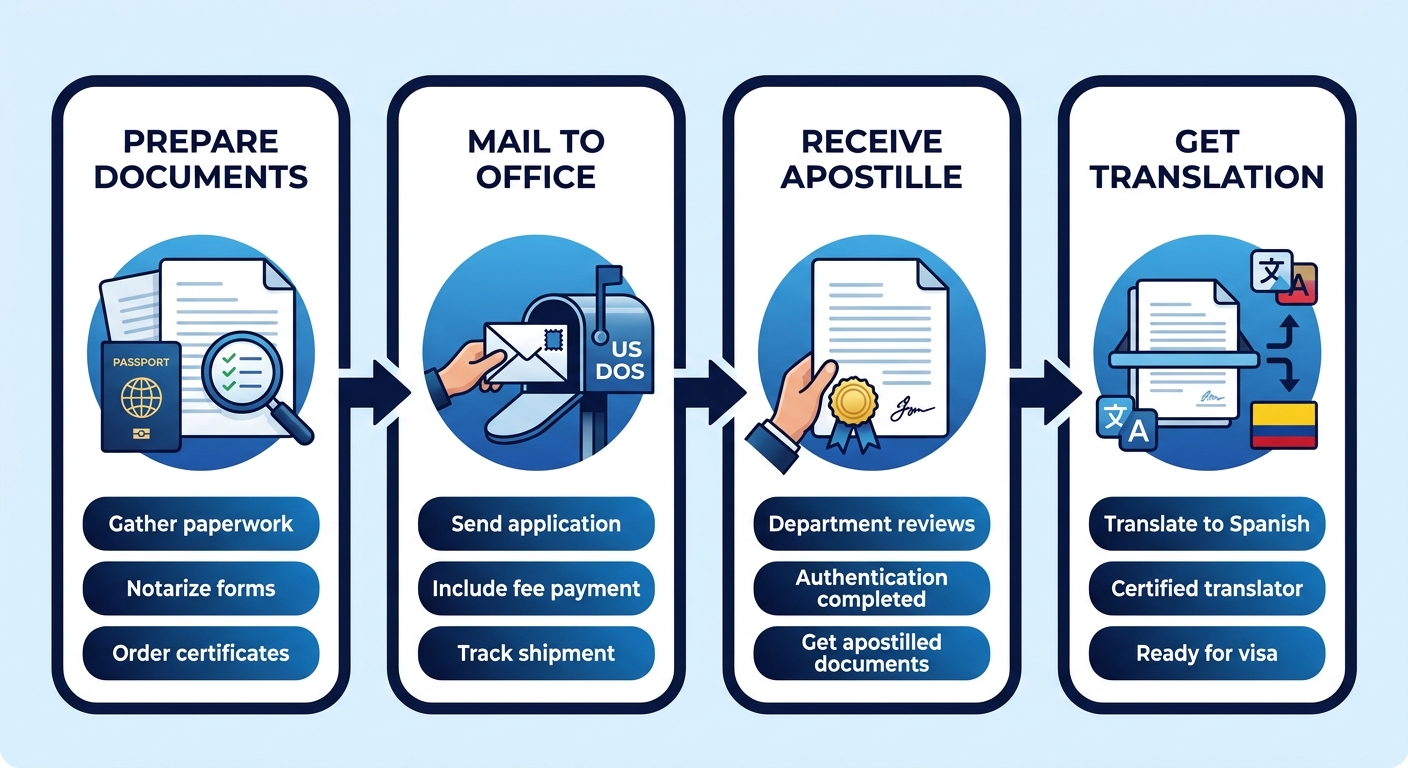
Following the addition of an apostille, a certified Spanish translation provided by a translator who has been registered with the Colombian Ministry of Foreign Affairs is mandatory. This step needs to occur once the apostille has been applied, prior to submitting your application for a visa.
4. Budget for Apostille and Translation Fees
The last step once you get your document apostilled is budgeting money to pay for both the apostille and its subsequent Spanish translation. In the US, apostille costs vary between states as well as between types of document being apostilled: a state-level apostille obtained at your Secretary of State’s office will be cheaper than a federal apostille obtained at the Department of State. Having understood what apostille papers cost can help veterans make informed financial plans and ensure they set aside the correct amount of money. It also pays to double check these costs with the relevant office. Finally, a guide has pointed out that there are exceptions for some forms of the Colombian visa that allow for electronic apostilles instead of traditional paper-based versions. However, this must still be verified with the Ministry of Foreign Affairs. As each document—such as a birth certificate, marriage certificate, or police clearance—requires its own apostille and certified translation, budget for multiple pieces. Translation into Spanish using a translator registered in the Colombian Ministry of Foreign Affairs must be certified; costs vary between COP 80,000 and 200,000 pesos per page ($20-$50 per document), according to that guide. This certification occurs last when all other expenses have been paid.
5. Get Certified Spanish Translations
In order to have an apostilled document accepted at Colombian immigration agencies, it must contain certified translations in Spanish. This means that foreign-language documents must be accompanied by an official Spanish translation performed by a translator certified with the Ministry of Foreign Affairs. According to two guides, a notary public or a Colombian consulate cannot provide this service for federal documents such as an FBI background check. To avoid application delays or outright rejection, applicants should secure translations from a professional service well before the intended submission date and request both physical and digital copies. Since they can't be submitted without having been authenticated with an apostille and translated into Spanish, most people choose to buy them as a bundle through a single service. Once all of those steps are complete, veterans who wish to retire there can move onto deciding where to go, whether it'll be a small town up in the mountains called Cocorná, or somewhere else within the department of Antioquia.
6. Find Your Safe Retirement Haven
With apostilled documents, certified translations, and direct deposit arrangements in hand, U.S. veterans can shift their focus to choosing a retirement haven that offers both security and community. Colombia’s Country List 2 status keeps Social Security benefits uninterrupted for most primary workers, as a field guide confirms. The Pensionado visa requires only a monthly pension at three times the minimum wage (about $1,723 USD in 2026) with apostilled and translated documents, as that guide outlines. The Cocorná area, with its Río Cocorná waterfalls, easy access to Medellín and Guatapé, and a warm mountain climate, provides a naturally safe and scenic backdrop. An all-inclusive residence adds practical security: private rooms, three meals daily, utilities, and a vetted veteran community with transparent pricing starting at $2,200 per month. Trial weeks let veterans test the rhythm of life in Cocorná before committing long-term. The next move is to plan a visit or apply for a trial stay and feel the haven firsthand.
Your Next Path to Retirement in Colombia as a Veteran
Preparing apostilled documents for a Colombia retirement visa is a central step for U.S. veterans retiring abroad, alongside meeting Pensionado visa income requirements and confirming Social Security remains active under the SSA’s Country List 2. Veterans must demonstrate a monthly pension of at least three times the Colombian minimum wage, with all foreign documents apostilled and translated. After visa approval, registration for a Cédula de Extranjería is required within 15 days. Social Security payments can continue via direct deposit into a U.S. dollar–denominated Colombian bank account. The community is not a medical or therapy program; this educational information is not professional advice, and individual circumstances vary. With proper planning, retiring in Colombia can be a rewarding next chapter.
Explore Retirement Living in Cocorná
You now have a clear roadmap for apostilling and translating the documents required for your Colombia retirement visa. With your FBI background check and Social Security award letter in order, the bureaucratic hurdles are behind you. The next step is choosing the right place to call home. Cocorná, Antioquia offers a tranquil mountain pueblo with waterfalls, a mild climate, and proximity to Medellín. An all-inclusive residence provides a community-focused environment with private rooms, meals, and amenities. Trial stays allow you to experience the area firsthand before committing. Take the next step toward your retirement in Colombia and explore the residence today.
Explore Retirement Living in Cocorná