Can a Felon Get a Visa: Complete Guide to Travel Eligibility
Table of Contents
- Can a Felon Get a Visa in Colombia?
- Criminal Record Does Not Automatically Disqualify You
- How Colombian Authorities Evaluate Criminal History
- FBI Background Check: A Key Requirement for Colombian Visas
- What Convictions Can Derail a Colombian Visa?
- Legal Assistance for Visa Applications with a Felony Record
- Next Steps and Resources for Your Colombian Visa Journey
Can a Felon Get a Visa in Colombia?
Can a felon get a visa in Colombia? A felony conviction does not automatically disqualify an applicant from obtaining a Colombian visa. Immigration authorities evaluate each application on a case-by-case basis, weighing the nature of the offense and the time that has passed since the conviction.
Veteran Housing Colombia is a resource for US vets interested in their Colombian visa process. They remind everyone, including those with a criminal history that you will need to submit an FBI Background check. If you have one, you are required under resolution 5477, this also applies to migrants, residents & pensioners visa application types. Being convicted previously doesn't automatically result in a denial of your visa application. The focus instead shifts based on what crimes were committed and when.
Criminal Record Does Not Automatically Disqualify You
It should be known that having a criminal record doesn’t mean you won't obtain your visa for Colombia. Each case will be assessed on its own merits depending upon the applicant’s individual background when considering their request.
According to Veteran Housing Colombia's visa guidance, officials consider the nature, severity, and age of any criminal offense. Minor infractions or incidents that happened many years ago rarely lead to an automatic denial. Instead, those older or less serious matters may be viewed favorably when an applicant has otherwise shown stability and compliance. The authority retains full discretion, but the approach is designed to avoid rigid blanket bans; it is the specific facts of the record that matter.
Criminal background checks are also necessary from all visa applicants in the three categories of migration, residence, and pensioners, as required under resolution No. 5477. The required document for US citizen’s visa application shall be their FBI Identity History Summary Check, which includes any arrest history, charges filed against them, or the outcome of their cases. Once they obtain such summary, they have to have it apostilled by the U.S. Department of State in order to make sure it is valid internationally. It will then require a certified Spanish translation of said summary before submission along with the other documents needed on the visa application form. Obtaining the FBI Identity History Summary Check, having it apostilled and having a Spanish translation done make certain that the applicant has fulfilled the documentation requirement imposed by Colombia.
Immigration officers are ultimately the ones who make the decision regarding these applications and they must carefully consider them all before making their choice. The organization advises anyone with a criminal record to consult with a qualified immigration lawyer about his/her situation. The lawyer will look at the situation as a whole and give advice whether there is any way he/she believes the record will be considered favorably when presented for immigration purposes. However, while each application is unique, the rule of thumb is that having a criminal background is not necessarily grounds for automatic denial for living in Colombia.
When Colombian officials look at an application, they take into account things like how serious the crime was, and how long ago it took place.
How Colombian Authorities Evaluate Criminal History
A criminal conviction in the United States does not automatically bar a person from obtaining a Colombian visa. Colombian immigration authorities assess every application on a case-by-case basis, weighing the specific details of the applicant’s history rather than applying a rigid rule.
According to Veteran Housing Colombia, the evaluation centers on three key factors:
- The severity of the offense
- The time that has passed since the offense
- The nature of the crime
Under Resolution 5477, applicants for migrant, resident, and pensioner visas must submit a criminal background check.
The authority’s goal is to determine whether the applicant poses a threat to public order or national security. Veteran Housing Colombia notes that many applicants with past records can still qualify if the underlying facts are not severe.
To meet the background check requirement, the applicant must provide an FBI Identity History Summary Check. The site explains, the FBI document must be apostilled by the U.S. Department of State; a stamp from a local notary or consulate is not acceptable. The State Department’s authentication office processes apostille requests and can take several weeks. All foreign-language documents must be translated into Spanish by a certified official translator (traductor oficial) in Colombia before they can be accepted by immigration authorities. Failure to provide a valid apostille or certified translation will result in the document being rejected. During the review process, officials may request additional documentation, and applicants have a 10-day window to respond. Missing this deadline can lead to delays or denial. The site also emphasizes that the FBI background check must be recent, typically obtained within six months of the application, and obtained through an official channel.
When an offense is minor or took place many years ago, Colombian authorities typically view it more favorably. The reviewing officer examines the entire history and assesses whether the offense indicates any ongoing risk. The organization notes that an applicant with a single low-level infraction from a decade ago is in a stronger position than someone with recent serious charges.
FBI Background Check: A Key Requirement for Colombian Visas
For U.S. citizens pursuing residency in Colombia, the FBI Identity History Summary Check serves as the mandatory federal criminal record verification under Colombian Resolution 5477. The regulation applies to applicants for migrant, resident, and pensioner visas, requiring this federal-level check regardless of an applicant’s clean record.
- Request the FBI report – Complete a fingerprint card and submit the application to the FBI either online or by mail. The bureau processes the request and returns the Identity History Summary.
- Obtain a federal apostille – Since the United States and Colombia are both parties to the 1961 Hague Convention, the U.S. Department of State authenticates the FBI document with an apostille. This certification verifies the signature and seal of the issuing federal agency.
- Secure a certified Spanish translation – All documents submitted to Colombian immigration must be in Spanish. A certified professional translator prepares a version that is legally equivalent and acceptable to immigration officials.
Skipping the apostille or using an uncertified translation is one of the most common reasons for visa application rejections.
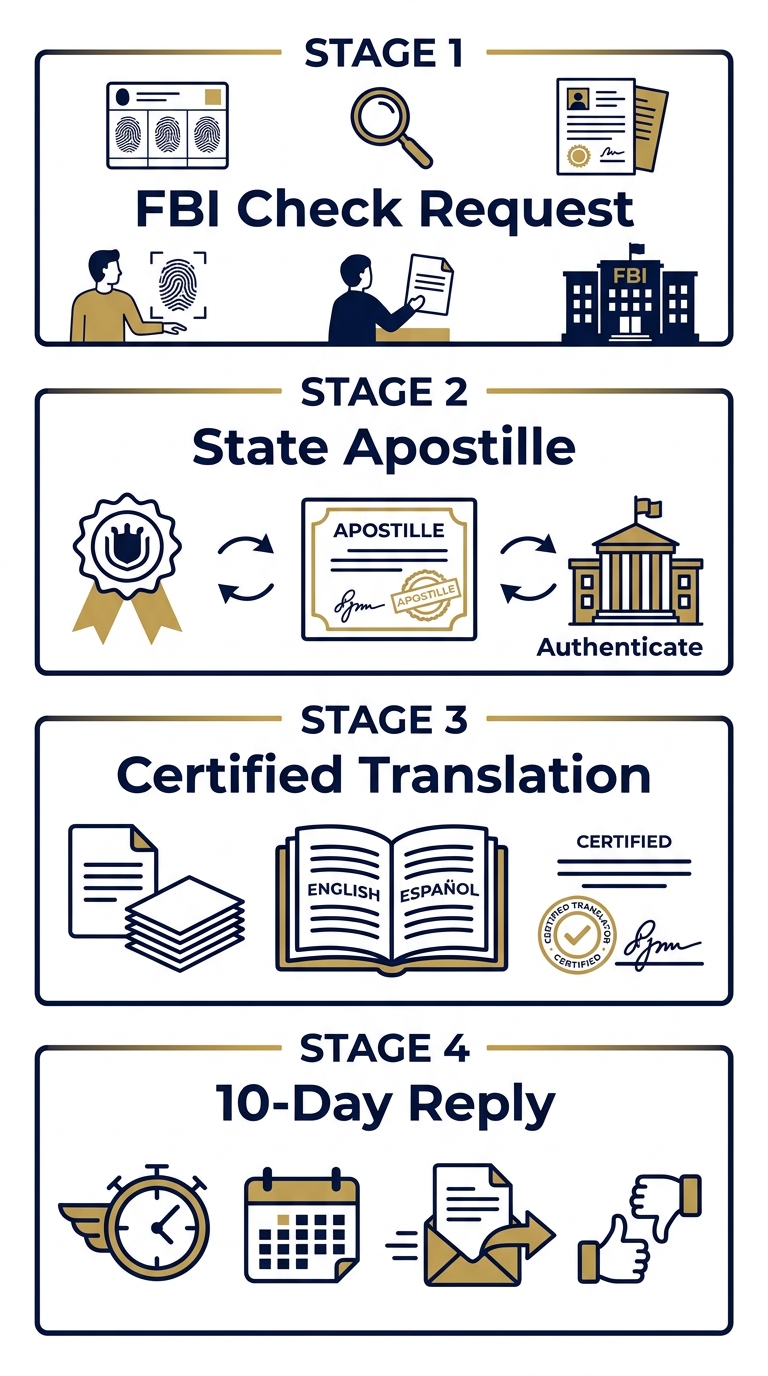
Once the apostilled and translated report is complete, the applicant can include it with the visa application package. Having a criminal record does not automatically end the visa journey. According to the site's FAQ, Colombian immigration evaluates each case individually, considering factors like the nature of the offense and how long ago it occurred. Minor or decades-old incidents are not automatic disqualifiers. However, immigration officers may request additional documentation to clarify details, and applicants typically have 10 days to respond. For applicants with more complex histories, consulting a licensed immigration attorney can provide a clearer picture of potential outcomes.
While the FBI Identity History Summary Check is a mandatory step, the specific nature and severity of any conviction ultimately play a decisive role in immigration decisions.
What Convictions Can Derail a Colombian Visa?
A criminal record does not automatically disqualify an applicant from obtaining a Colombian visa. Colombian immigration authorities evaluate each case individually, weighing the nature, severity, and recency of the offense rather than applying a blanket rule. As Veteran Housing Colombia’s FAQ on visa applications explains, there is no published list of crimes that guarantee rejection, and officials retain full discretion over every decision.
Minor offenses or convictions that happened many years ago are generally not automatic grounds for denial. The evaluation process considers how long ago the incident occurred and whether it reflects a pattern of behavior. That said, any criminal history triggers extra documentation requirements under Resolution 5477, the regulation that governs migrant, resident, and pensioner visa applications.
Applicants who must disclose a record need to prepare several specific documents:
- An FBI Identity History Summary Check, which provides a complete U.S. criminal background report.
- An apostille issued by the U.S. Department of State—local notary stamps or consulate certifications will not satisfy Colombian immigration.
- A certified Spanish translation performed by a traductor oficial (official translator) in Colombia.
- A commitment to respond to any follow-up document requests within 10 days; missing that window can delay or derail an application.
Failing to meet any of these steps can stall the visa process even when the underlying conviction is old or minor. The guide on avoiding visa rejection in 2026 points out that administrative errors often cause more trouble than the criminal history itself. Because the final outcome rests with the immigration officer, a complete, correctly authenticated file is essential.
For applicants whose history includes a felony or multiple incidents, professional legal guidance often becomes valuable. A licensed Colombian immigration attorney can assess how a specific record might be viewed and help present the strongest possible case. For those whose history introduces uncertainty, professional legal counsel can provide a fuller picture—an avenue many applicants choose to pursue.
Legal Assistance for Visa Applications with a Felony Record
Given the potential complications that certain convictions can introduce, veterans with a felony history often benefit from experienced legal guidance when applying for a Colombian visa. Colombian immigration reviews prior criminal history on a case-by-case basis, meaning that a minor offense does not automatically result in denial. Still, the application process demands precise documentation, and even small administrative missteps can lead to rejection. Navigating this process with any criminal record adds another layer of complexity, making professional legal assistance not just helpful but often critical. Under Resolution 5477, Colombia enforces documentary standards that heighten this complexity.
The site's visa guidance, prepared by founder and disabled U.S. Army veteran Robert Bibb, highlights several documentation issues that regularly trip up applicants:
- FBI background checks must receive an apostille from the U.S. Department of State. A local notary or consular stamp is not sufficient for Colombian immigration purposes.
- All documents written in a foreign language require a certified translation by a Colombian traductor oficial. Submitting an unaccredited translation will cause the application to be rejected outright.
- Applicants have a strict 10-day window to respond if immigration requests additional documents. Missing that deadline can result in denial, regardless of the underlying eligibility.
An experienced immigration attorney can manage each requirement: securing the correct apostille, arranging certified translations, and meeting all response deadlines. While no attorney can guarantee visa approval, professional oversight significantly lowers the risk of an administrative rejection, letting veterans with a record present the most complete application possible.
With legal support in place, veterans can then focus on gathering the specific documentation needed, such as affidavits, background checks, and supporting evidence, and take the next concrete steps toward their Colombian residency. They should prioritize apostilled FBI checks, certified translations, and respond within the strict 10-day window for requests.
FAQ
What types of criminal convictions are most likely to lead to a visa denial in Colombia?
Colombian immigration authorities do not publish a list of offenses that guarantee visa denial. Instead, they weigh the severity, nature, and how recently the crime occurred. Serious, recent convictions are more likely to result in rejection than minor or decades-old infractions. Each case is decided individually, and officials retain full discretion.
Can I seek legal assistance or an immigration specialist to help with a visa application if I have a prior felony?
Yes, you can seek legal assistance. Veteran Housing Colombia advises applicants with a prior felony to consult a licensed immigration attorney. A lawyer can evaluate your specific record, ensure mandatory documents like the apostilled FBI check and certified translations are correct, and help present the strongest possible application to immigration authorities.
Is a criminal record an automatic disqualification for a Colombian visa?
No, a criminal record is not an automatic disqualification. Under Colombian Resolution 5477, authorities evaluate each application individually, considering the offense’s nature, severity, and recency. Minor or old incidents rarely lead to denial, but applicants must still submit an apostilled FBI Identity History Summary Check and a certified Spanish translation.
How does the Colombian government evaluate criminal history during the visa application process?
Colombian authorities evaluate criminal history case by case, weighing the severity of the offense, the time that has passed, and its nature. They determine if the applicant poses a threat to public order. Applicants must provide an FBI Identity History Summary Check, apostilled by the U.S. Department of State, along with a certified Spanish translation.
Do I need to submit an FBI background check when applying for a Colombian pensioner visa?
Yes, a pensioner visa requires a federal criminal background check. Under Resolution 5477, all migrant, resident, and pensioner visa applicants must submit an FBI Identity History Summary Check. The document must be apostilled by the U.S. Department of State and translated into Spanish by a certified translator before the application is complete.
Next Steps and Resources for Your Colombian Visa Journey
If you are wondering can a felon get a visa for Colombia, the answer depends on individual circumstances. Colombian immigration does not automatically reject applicants with a criminal record; each case receives an individual evaluation.
Applicants will have to undergo what’s required by the Colombian Immigration via Resolution No. 5477, that is, obtain an FBI Identity History Summary Check. Then they just need to get that apostilled with the help of US Department of State, followed by translation done in Spanish by any certified translator. In any case, minor offences or those committed decades ago usually do not result in immediate rejections.
The consultation of an immigration attorney who specializes in Colombian visas can give us a clearer picture of eligibility and help assemble the documentation needed to obtain such status. Also, this residence is neither a medical institution nor a place to get therapy. The information here is educational and is not a substitute for professional legal or medical advice; individual circumstances and outcomes vary.
Continue Your Visa Journey
You now have a clear understanding of how a felony conviction affects Colombian visa eligibility and the steps required to proceed. The case-by-case evaluation process, the mandatory FBI background check, and the importance of certified translations are key elements covered in this guide. While eligibility depends on individual circumstances, proper documentation and legal guidance greatly improve your application's chances. The site offers detailed resources and field guides to help you navigate the entire relocation process, from visa requirements to housing options in Cocorná. Explore the comprehensive resource hub to find step-by-step instructions on gathering documents, understanding local regulations, and connecting with a veteran community. Whether you're ready to start your application or simply want to learn more about life in Colombia, the next stage of your journey is just a click away. Your path to a new chapter in Colombia begins with the right information and support.