What Are the Most Common Reasons for a Visa Being Denied: Expert Guide
Table of Contents
- Why Colombian Visas Get Denied: A Guide for U.S. Veterans
- What Are the Most Common Reasons for a Visa Being Denied in Colombia?
- Why Documentation Failures and Financial Inconsistencies Lead to Visa Rejection
- What to Do If Your Visa Is Denied: Steps for U.S. Veterans
- Navigating Discretionary Denials and Security Concerns
- Frequently Asked Questions About Colombian Visa Denials
- Keys to a Successful Colombian Visa Application
Why Colombian Visas Get Denied: A Guide for U.S. Veterans
Knowing the most common reasons for a visa being denied in Colombia is essential for U.S. veterans applying in 2026. According to VeteranHousingColombia’s FAQ on visa rejection avoidance, the primary causes are improperly authenticated federal records—such as FBI Identity History Summary checks—and translation by uncertified services. Colombian immigration under Resolution 5477 demands official apostilles from the U.S. Department of State and certified official translators, rejecting automated tools and local notary stamps. Understanding these document requirements early prevents unnecessary denials.
In 2026 U.S. veterans navigating Colombian visas would encounter a process where precise documentation is paramount. Three problems arise frequently here: improper authentication (for example, using a local notary for the FBI check apostille when it should really have been done at the Department of State level); translation mistakes (using an automated tool that has no legal validity and not employing a traductor oficial); and procedural error such as missing a 10-day deadline for additional information or sending back incompletely completed documents. The Colombian authorities impose these standards very strictly and even a properly signed document could be refused if there was any problem with its certification or translation. These problems are all avoidable with proper preparation. A single oversight can delay a veteran’s relocation by months and may require a fresh application under new requirements. The most common reason why people have their visa applications denied falls into a small number of categories which are addressed in turn below.
Key Takeaways
- Among the most common reasons for visa refusal in Colombia are improper authentication and incomplete translation of federal records.
- Colombia’s immigration agency most often rejects visa applications because applicants fail to submit necessary documentation or to show sufficient funds for their stay, which undermines their credibility under Resolution 5477.
- A visa denial can feel like a significant setback, but it often points to fixable documentation issues rather than a permanent barrier.
- Colombian immigration officials exercise discretionary authority when reviewing visa applications: each case is evaluated individually.
- If an application has been rejected, part of the worry about the rejection may be due to past legal issues.
What Are the Most Common Reasons for a Visa Being Denied in Colombia?
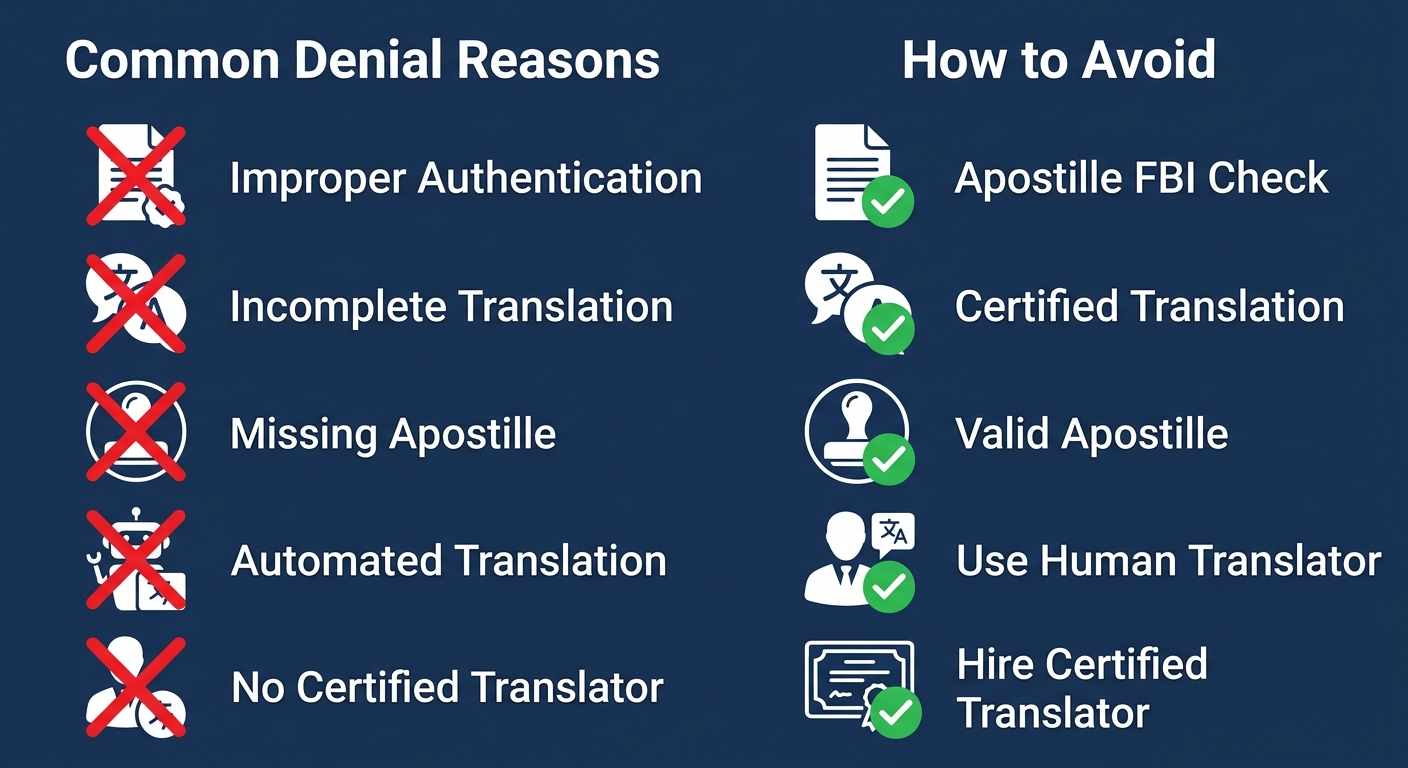
Among the most common reasons for visa refusal in Colombia are improper authentication and incomplete translation of federal records. These problems often arise when travelers who aren't familiar with resolution 5477 attempt to make submissions.
Here you will find some common types of refusal triggers as well as the reason why they happened and how they could have been prevented.
| Denial Reason | Typical Cause | How to Avoid |
|---|---|---|
| Improper authentication of federal records | Submitting federal documents without the required apostille from the U.S. Department of State; local notary or consular stamps are not accepted. | Ensure the U.S. Department of State apostille is obtained for each federal record before submission. |
| Incomplete translation of documents | Providing documents in their original language without a full, certified Spanish translation. | Have every foreign-language document translated in full by a Colombian-certified official translator. |
| Failure to apostille the FBI Identity History Summary | The FBI background check is a federal record that must carry a USDOS apostille; omitting this step leads to automatic rejection. | Submit the FBI Identity History Summary only after it has been apostilled by the U.S. Department of State. |
| Use of automated translation tools | Submitting machine-translated documents (e.g., Google Translate) that Colombian immigration does not consider legally valid. | Rely exclusively on a human, certified traductor oficial for all translations; automated tools are unacceptable. |
| Lack of a certified official translator | Attempting to self-translate or use an uncertified individual, which fails to meet the court-certified translation standard. | Engage a licensed Colombian translator who is registered as a traductor oficial for all needed documents. |
Veteran Housing Colombia reminds applicants that immigration authorities allow only ten days to respond to any request for additional documents; missing that window can lead to denial. Anyone who has any criminal history should consult a licensed immigration attorney, since minor or historical offenses do not always result in rejection. If a veteran secures the correct apostille and a certified translator before submission, it helps avoid processing delays and reduces the risk of refusal.
Though such mistakes occur frequently during the application process, other problems have arisen for applicants where there were irregularities in their financial statement, their bank letter, or other types of evidence that didn't comply with what was needed. Careful preparation is advised if you want your Colombian visa application to be processed without complications.
Why Documentation Failures and Financial Inconsistencies Lead to Visa Rejection
Colombia’s immigration agency most often rejects visa applications because applicants fail to submit necessary documentation or to show sufficient funds for their stay, which undermines their credibility under Resolution 5477. By getting familiar with those types of problems, you, as a veteran, can better prepare applications that withstand scrutiny from immigration officials.
Below is a comparison between what needs to be done correctly and some mistakes made often enough to cause rejections in applying for visas through the Colombian system for veterans:
| Required Document | Correct Procedure | Common Error | Consequence of Error |
|---|---|---|---|
| FBI Identity History Summary | Apostilled by the U.S. Department of State and professionally translated into Spanish by a certified translator (automated tools rejected). | Missing apostille or using an automated/machine translation. | Document rejected under Resolution 5477, leading to visa denial. |
These are precisely the points that reflect the framework governing document authentication and translation for Colombian visa applications, and overlooking even a single step can unravel an otherwise complete submission.
The Apostille and Translation Pitfall
The Colombian immigration authority rejects any translations produced by automated online tools outright. According to resolution No. 5477, documents must be translated manually by certified human translators if you want them to be accepted officially in Colombia. Therefore, according to the regulations set forth by the country’s immigration system, the translated texts delivered via machines should not be considered legal translations.
Federal documents originating in the United States face an additional authentication hurdle. In order for an FBI Identity History Summary Check to pass scrutiny, a special type of certification known as Apostille issued by the US Department of State must be attached, rather than a simple notarial stamp from any local bank or clerk’s office. Neither consular officials nor notary publics have the necessary legal standing to verify such federal documents, which means all other background checks stamped with mere notarial seals will be rejected outright.
Even applicants who have a criminal background can apply for a Colombian visa as long as the criminal record check is apostilled and professionally translated. However, if either step isn't completed, the document will fail the authentication standard set forth in Resolution 5477, and officials have no mechanism to accept an improperly prepared submission.
Financial Documentation Mistakes That Trigger Denials
The suspicion generated in view of financial inconsistencies will be interpreted as a credibility concern by the immigration authorities acting in compliance with resolution n°5477. If these income sources could not be properly documented and/or if the bank account balance reported on a recent statement displays several irregularities, the officer cannot make sure that this individual has the required amount of money necessary for obtaining his/her visa.
When a veteran is applying for disability benefits or pension payments and does not submit official award letters or other documents verifying his VA benefits, undocumented VA benefits present a recurring problem for him. And when applicants combine income from multiple sources and submit bank statements that do not clearly correlate with the claimed income streams, it raises a red flag.
Resolution 5477 does not mandate a single minimum bank balance, but it does require that financial documentation withstand basic verification. When an applicant fails to demonstrate a consistent and traceable source of funds, the reviewing authority concludes that the financial picture is incomplete, which helps explain why a visa would be denied due to document errors that erode the credibility of the entire application. Recognizing these common documentation and financial pitfalls is the first step; the next section outlines what to do if your visa is denied.
What to Do If Your Visa Is Denied: Steps for U.S. Veterans
A visa denial can feel like a significant setback, but it often points to fixable documentation issues rather than a permanent barrier. When veterans understand the common reasons for denial, they can take concrete steps to respond with a corrected, strengthened application that addresses each concern directly.
This action plan describes three phases that should be followed when facing a visa rejection in Colombia.
| Action | What It Involves | Key Documents | Typical Timeline |
|---|---|---|---|
| Decode Denial Notice | Review the denial letter for specific cited reasons—especially authentication or translation failures | Denial letter, FBI Identity History Summary (if mentioned) | Immediate (a few hours to 1 day) |
| Build Corrected Package | Obtain required apostilles, certified professional translations, and updated financial proof | Apostilled FBI background check, certified Spanish translation, bank statements or proof of income | 1–3 weeks (apostille + translation processing) |
| Reapply with Strengthened Evidence | Submit a new visa application with a cover letter that directly addresses each reason from the denial | New application form, corrected documentation package, cover letter | Varies; check current processing times on the Colombian consulate website |
The biggest thing you want to understand about this letter is WHAT the denial actually says, as that will guide all the things that follow.
Decoding the Denial Notice
The first thing you have to do is to go over the denial letter written by Colombian Immigration department and identify why they rejected your visa. According to a guide on how to avoid a visa rejection, most denials happen because applicants didn’t follow proper procedures in their document authentication or don’t make use of certified translation services. There would be some sentence in their denial notice which says that they weren’t apostilled properly or that the translation isn’t satisfactory enough.
In any instance where the Notice mentions the FBI IDHSC, make certain to determine if the problem is related to authentication issues, translations, or both. While having a criminal record does not automatically disqualify an applicant—approval is determined case-by-case at the discretion of Colombian immigration officials—the background check must still be apostilled and professionally translated into Spanish.
Building a Corrected Documentation Package
Veteran Housing Colombia's visa guidance emphasizes three non-negotiable requirements:
- Apostille through the U.S. Department of State: Federal records like the FBI Identity History Summary cannot be authenticated by local notaries or consulates. Only the U.S. Department of State holds authority to issue the apostille.
- Certified professional translation: Colombian immigration rejects automated translation tools and uncertified translators. All documents must be translated by an official certified translator, known as a traductor oficial, to satisfy requirements under Resolution 5477.
- Updated financial proofs: If the denial cited insufficient financial documentation, include recent bank statements or proof of income that clearly demonstrate the ability to support the stay in Colombia.
Reapplying with Confidence
Send in the new visa application if you have resolved all issues mentioned on your denial notification. Submit a cover letter that refers back to your previous rejection and explain what has changed in relation to any problems listed on the document. Also make sure the reason for your trip will remain the same.
Obtain the proper apostilles, certified translations, and any additional evidence requested. The Colombian immigration office will evaluate each case separately and it’s better to send in a thoroughly completed application rather than to resend hastily. If your denial stems from anything other than the documentation, such as a discretionary decision on the part of the officer or security issues, there may be some problems.
The guidance recommends that people who have complicated pasts, including criminal records, consult a licensed immigration attorney for case-specific guidance before reapplying.
Navigating Discretionary Denials and Security Concerns
Colombian immigration officials exercise discretionary authority when reviewing visa applications: each case is evaluated individually. A discretionary denial happens when an officer determines an applicant’s background—a criminal record—creates security concerns that outweigh the visa’s purpose. A criminal record does not automatically bar an applicant, but applicants must provide strict documentation: an FBI Identity History Summary Check apostilled by the U.S. Department of State and professionally translated into Spanish. Authorities consider the nature and timing of offenses on a case-by-case basis; minor or aged convictions are generally treated less severely than recent, serious crimes, and the publisher advises consulting a licensed immigration attorney when needed.
| Scenario | Immigration Concern | Recommended Veteran Response | Supporting Evidence |
|---|---|---|---|
| A veteran with a minor misdemeanor (disorderly conduct) from over ten years ago. | An old, minor conviction is less likely to trigger a discretionary denial but will still be reviewed. | Include an apostilled FBI background check with a certified Spanish translation, submit references, and explain rehabilitation in a cover letter. | The FAQ stresses individual evaluation and requires an apostilled FBI Identity History Summary Check and a professional Spanish translation. |
| A veteran convicted of a non-violent felony drug possession five years ago. | A moderate offense may draw closer scrutiny and raise security concerns during discretionary review. | Provide the apostilled FBI check and translation, include court records showing sentence completion, add character references, and consult an immigration attorney. | The resource recommends a complete file demonstrating rehabilitation and the required apostilled and translated background check. |
| A veteran with a recent conviction for a violent crime such as assault. | A recent, serious offense is likely to raise significant security concerns and may lead to denial. | Still submit full, apostilled documentation and translations, but obtain counsel from a licensed immigration attorney to explore possible waivers. | Visa approval is discretionary; recent severe criminal history is more likely to result in denial, per the FAQ guidance. |
Frequently Asked Questions About Colombian Visa Denials
If an application has been rejected, part of the worry about the rejection may be due to past legal issues.
Q: Can I apply for a Colombian visa if I have a criminal record?
A: A criminal record will not always result in denial of application for a Colombian visa. Immigration officials assess each application on an individual basis. However, under Resolution No. 5477, they will consider on a case-by-case basis what type and when the offense occurred.
If you want to apply for Migrant, Resident or Pensioner visas, applicants must provide a federal FBI Identity History Summary Check that has been apostilled by the U.S. Department of State and professionally translated into Spanish.
A visa might be granted at their discretion depending upon the officers’ opinions.
Knowing which paperwork and instructions you should gather puts you on the right path toward a successful Colombian visa application.
Short FAQ
What are the most common reasons for a Colombian visa being denied for U.S. citizens?
The most common reasons are improper authentication of federal records and incomplete or uncertified translations. Colombian immigration under Resolution 5477 rejects documents that lack a U.S. Department of State apostille or that were translated by automated tools or non-certified translators, which are common errors for applicants unfamiliar with the requirements.
How does the lack of proper documentation or apostilled records lead to a visa denial in Colombia?
Lack of proper documentation leads to denial because Colombian immigration strictly enforces Resolution 5477. Federal records like the FBI background check must carry an apostille from the U.S. Department of State—local notary stamps are rejected—and all documents must be translated by a certified official translator, as automated tools are considered legally invalid.
Can providing inconsistent financial information or unverified income sources result in a visa application rejection?
Yes, providing inconsistent financial information or unverified income sources can result in rejection. Immigration officials cannot verify the applicant’s financial capacity when bank statements do not clearly correlate with claimed income, which undermines the credibility of the application and may cause a denial under Resolution 5477’s verification standards.
Why might a Colombian visa be denied due to government discretionary power regarding security or national concerns?
Colombian immigration officials exercise discretionary authority and evaluate each case individually. A visa may be denied if officials determine that an applicant’s background raises security or national concerns, even when standard documentation is in order, because approval rests on their case-by-case assessment of the applicant’s overall situation.
What steps should a veteran take if their residency visa application is denied due to incomplete or ambiguous documentation?
A veteran should first review the denial letter to identify the specific documentation issues cited. Then, obtain the correct U.S. Department of State apostille for federal records and secure certified translations from an official translator. Finally, reapply with a new application packet and a cover letter that directly addresses each reason given for the denial.
Keys to a Successful Colombian Visa Application
Understanding what are the most common reasons for a visa being denied is the first step toward a successful application. Most Colombian visa denials stem from improper authentication or incomplete translation of U.S. federal records, especially the FBI Identity History Summary check.
Only the U.S. Department of State can apostille FBI reports; Colombian immigration requires translations by a certified translator, and automated translations are rejected. The residence is not a medical program; this guidance is educational, not a substitute for professional medical, legal, or VA-benefits advice, and outcomes vary.
Get Expert Visa Support Now
You now understand that most Colombian visa denials stem from improper authentication and incomplete translation of federal records like the FBI background check. The apostille requirement from the U.S. Department of State and the need for certified official translators—not automated tools—represent critical steps that can make or break your application. With Resolution 5477 setting strict documentation standards, navigating this process alone can put your application at risk. Expert guidance helps U.S. veterans avoid the common pitfalls covered in this guide. Resources specifically designed for veterans planning to relocate are available. Taking the next step with professional support can make the difference between denial and approval. Your path to a successful Colombian visa application starts with the right guidance.